Govern every AI agent, and prove what each one is worth.
Quayside sits between AI agents and the models they call. It applies an organisation's policy to every call, and ties the work each agent does to evidenced business outcomes.
The agents arrived. The governance hasn't.
Which agents exist?
Nobody keeps the list. They appear on laptops, in pipelines, in scheduled jobs, in a home-built tool no one knows about.
What may they do?
No policy binds them. Whoever holds the key holds the permission.
What did they send?
Prompts and data leave unrecorded. There is nothing to show an auditor.
What did they cost, and what came back?
Token spend is a line item. Value is a shrug.
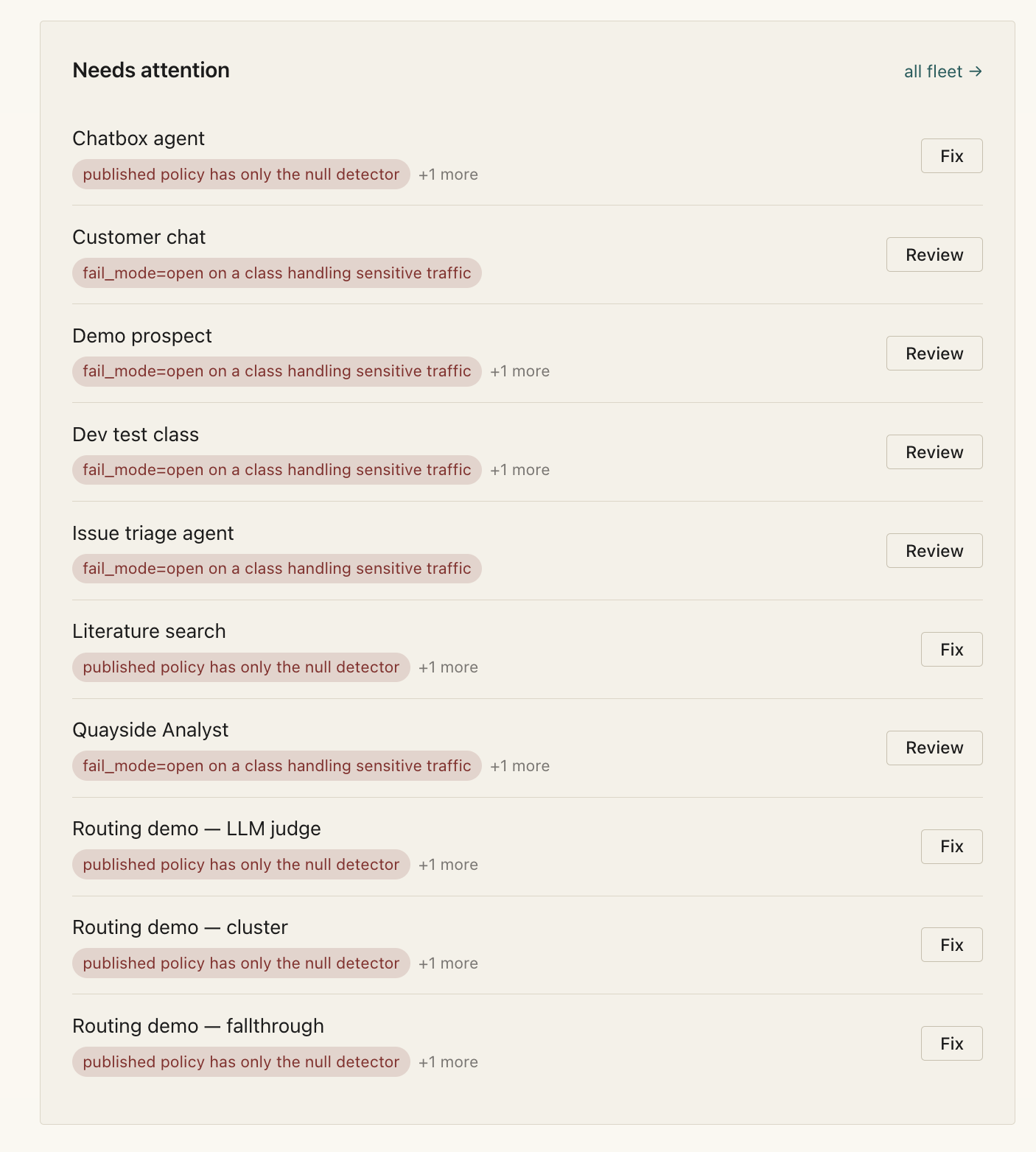
Policy enforced in the path of every call, before it reaches the model.
Since every call goes through one place, Quayside can also map what each agent depends on and show what a change would break.
Before the call.
Each agent is registered under a class, with a named owner. Policy belongs to the class, so a new agent picks up its guardrails the day someone builds it. Quayside holds the provider keys; agents never do.
During the call.
Detectors selected by the organisation check each request and each response. When two rules disagree, the stricter one applies. If the model asks to use a tool the policy forbids, Quayside removes that request before the agent receives it.
After the call.
Quayside records which policy version applied, what it decided and why, and what the call cost. What was in force at 14:00 last Tuesday is one query.
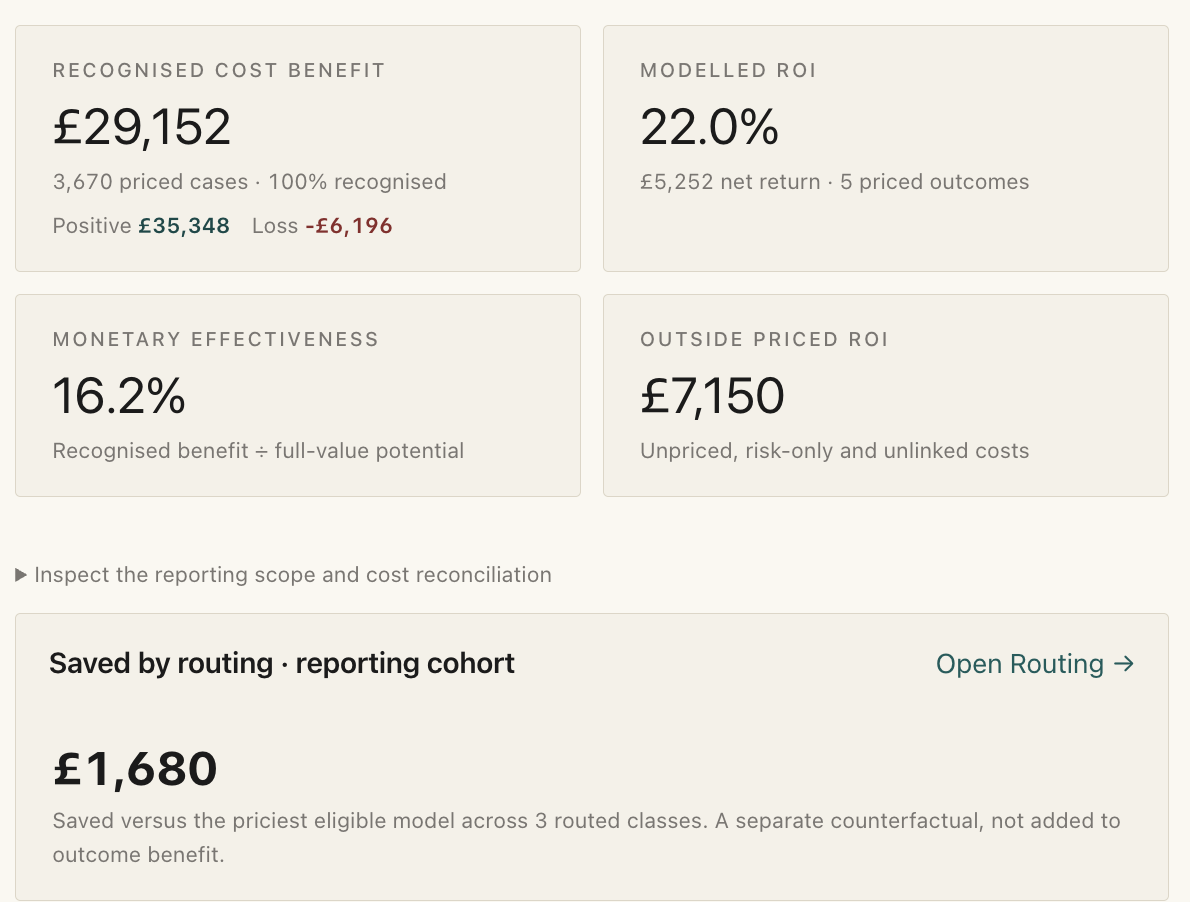
Cost is unconditional. Benefit is earned.
Quayside measures what the business gets back as well as what it spends. The measurement rests on four principles.
Outcome.
Value is assessed against a business outcome, not against a single agent. One outcome may be delivered by several agents working together, and Quayside measures the outcome and its total cost across all of them.
Assessment criteria.
The service owner defines criteria tied to the business outcome. Each piece of work is graded against them as full, partial, none or fail. Finance approves the financial indicators behind each grade, and Quayside retrieves them from connected systems or takes them in by import.
Evidence.
Every assessment rests on business records, never on an agent's own claim of success. A named person is accountable for each assessment, and nobody can enter a value by hand.
Cost.
Cost is counted for every attempt, including work that returned nothing, and across every agent involved: model usage, tools, platform and people.
Business records the organisation already keeps, never the agent's own claim.
Counted for every attempt, across every agent involved.
It runs inside the organisation's boundary.
Quayside runs as a single-tenant installation inside the customer's own environment. Prompts and responses stay within that boundary. It works with more than one model provider, and policies can be read and exported. A policy can also be set to fail closed, so that with a network rule in place an agent bypassing Quayside reaches no model.
What Quayside does not do.
- It sees only the calls that pass through it, so it does not scan laptops, browsers or software teams subscribe to.
- It supplies no models and builds no agents.
- It does not manage access to tools, though it can stop a tool request inside a response.
- Existing inventory and compliance systems stay in place. Quayside sends its decisions to them.
- It keeps a record of decisions and no copy of prompts or responses.
Start actioning on your AI governance with Quayside.
Start with three to five agents. Agents are picked jointly with the customer, across different levels of risk and value. That way the first report shows a range of results, including the unflattering ones.
Book a demo